Sunday, January 12, 2014

Tania: Surviving the Somme, suffering shell shock

A distant cousin Arthur Gutsell on my mother’s side was discharged on 28 March 1919 “in consequence of being no longer physically fit for war service.”

He had joined up in 1917 as a 20 year old farm labourer from  Nightcaps. One of 5 sons, his mother was already widowed when the boys were called up for service in WW1. Goodness  knows how worried she must have been when all five signed up and went to Europe.

Perhaps Arthur should never have gone. In Gore May 1917, he was seen by the doctor from the Travelling Medical Board. The military medical record describes him as 5 foot 5, dark hair and brown eyes and “in good bodily and mental health and free from any physical defect likely to interfere with the efficient performance of his duties”.  However, on the bottom of his health certificate the Dr comments: “This man has a slight flat foot and an old injury to his left eye, but is very keen.”  He had very poor eyesight in his left eye.

Following the doctor's report on 24 May 1917 Arthur was attached as a Private to the NZ Expeditionary Force 30th Reinforcements, Otago Infantry Regiment. He was sent to the Featherston Camp for training.

He must have been a bit of a lively lad as in August 1917 as he went AWOL twice and was docked several day’s pay in punishment.

Arthur spent 1 year 92 days in overseas service. He embarked from Wellington on troop ship no 93 destined for Liverpool. Arriving in the cold of December they marched 220 miles to the NZ training depot at Sling on the bleak Salisbury Plain, then on to Codford Camp, south of Salisbury where 2,400 NZers were stationed. By Jan 1918 while at Codford he was ill with influenza. Recooperated, in March 1918 they were sent to France for the battle of the Somme.

The NZ division was stationed at Auchonvillers near the Ancre River in the Somme area. Diaries say the NZ Division fought with colossal toughness as they had attracted the full attention of the enemy.  Shelling, new Whippet tanks, machine guns, mustard gas and air attacks took their toll with huge casualties and exhaustion on both sides. These battles, that we can see in retrospect through research into soldiers' diaries, were fraught with difficulties, poor communications and organisation. Allied back up troops often arrived late and were-ill informed of what was going on, so much so, that they were fired on by planes from the same side. Soldiers were terrified by the new Whippet Tanks, which had not been explained to them: they thought they were German tanks, when they were from the same side.

Whatever went on – Arthur's battle service was short, just three months in the field. By 6 June 1918 he had been transferred back to the camp and then Military hospital in Codford. In August  he was certified unfit for military service, not only because of the pre-war partial sight in his left eye, but also for hyperthroidism or shell shock.

At that time it was believed that men with such mental /psychological afflictions were cowards. Some were shot. Their families suffered more than grief but also the stigma involved.

Luckily Arthur survived because the New Zealanders had a strong medical response. Following treatment at Codford on 3 Dec 1919 he embarked from Liverpool for NZ via Tahiti. He was given a war pension, a silver war badge and a King’s Certificate. By 1921 he was awarded a British war medal.

He married in Dec 1919 and lived in Dunedin. His occupation was a labourer. They had two girls. Arthur died in 1959 aged 62. He had never kept good health.

~Tania Kopytko


Wednesday, November 13, 2013

Sue: Two years, three campaigns

My grandpa, Ronald Hayward Matthews, was a private (Serial No 12/597) in the 15th Regiment of the Auckland Infantry Battalion (Main Body, New Zealand Expeditionary Force).

He signed up on the 17th August 1914 and left New Zealand from Auckland aboard the HMNZT 12 (SS Waimana) on the 16 Oct 1914.  He disembarked at Port Suez on the 13 December 1914.

He and his brothers fought at Gallipoli for the whole duration and at the end they were evacuated around 20 December 1915 to Lemnos and then taken to Egypt where they celebrated Christmas.  

He then fought at Somme but was wounded just before 20 September 1916.  He was treated in Dublin.


He married my grandmother (Marionetta Euphemia Dinwoodie), who he met in Scotland, on the 18 February 1919, and eventually travelled back to work on the family farm just north of Kaitaia.

~ Sue Leask

Jenny: a governess in Georgia, a headmaster, and two soldiers

My Great Aunt Ethel (maternal side of my family) was born in Strabane, Northern Ireland, before moving to Galway at the age of 7. 

She spoke Russian, and was working as a midwife and governess in Russia during the Russian revolution in Georgia. She returned to Russia before her aristocratic employers were murdered.

Her fiance was killed in WW1 and as there was a man shortage, she never married. She later worked in India, South Africa and Belgium and lived to 101 years. 

Her brother, Henry Cox, was the eldest of 12 children, 8 of whom survived to adulthood.  Henry gained a triple first at Trinity College Dublin and supported his widowed mother and siblings through grammar school, becoming headmaster of Arundle School. Later, in WW2, he was a lecturer for the RAF. 

Ethel's other brother, Arthur, died in WW1.

Edwin Cossey (paternal side) was in a Scottish Army regiment in WW1. He met his future wife while training in Scotland. He married Janet after the war and moved to India to work for the American Cynamid Company.

Edwin died at work in his office, with the secretary wondering why he had stopped dictating.

~ Jenny Cossey

Friday, August 30, 2013

Jan: Blighted by the war

WILLIAM ARTHUR GARDINER

My grandfather Arthur joined the 18th Reinforcements as a volunteer in 1916 at the age of 20.

He was a skilled horseman and was in the Otago Mounted Rifles. He was in Egypt for initial training and then at Sling Camp on the Salisbury Plains in England. He saw action in France and Belgium in 1917-18, but was hospitalized at Etaples Training Camp in France suffering probably from shell shock. 

At the end of the war he was sent to Cologne to be part of the Army of Occupation in 1919. When he got home he was ill and was unable to keep food down — a result of being gassed.

Twenty-five years after the war he was diagnosed with severe depression related directly to his war experiences and triggered by the Second World War. At this time he was chairman of the local Patriotic Society and had to farewell the next generation of men, including his own sons, to fight overseas. 

He was sent to Seacliff Hospital where, like Janet Frame, he was given electro-therapy shock treatment. His health was blighted by the war, and he died at the age of sixty-eight.


Tuesday, August 27, 2013

Annie: The Battle of Messines — pillars of fire


My maternal great uncle Charles Joseph Ardern (1878-1920) aka Charles Harding was a Private in the 1st Battalion Auckland Infantry Regiment, Army number 15897.

He was stationed on the Western Front from 1916. His division moved to Flanders in February 1917, and he later took part in the capture of the Messines Ridge, Belgium.

The Battle of Messines was launched on 7 June 1917 with the detonation of 19 underground mines underneath the German lines.

There was stillness and silence for an hour preceding the attack …t hen the ground rocked and the air was filled with the sounds of the deafening explosion — the loudest man-made explosion to that point, as the sky lit up with towering pillars of fire.

The village of Messines was captured successfully by the New Zealanders, but they later suffered heavily from German bombardment, with more than 700 killed.

During the operation, Charles was in the frontline and was struck by a German 77mm field gun known as a whizz bang. He would have heard the terrifying whizz noise of a travelling shell before the bang of the gun itself, and had virtually no warning as the shell fired travelled faster than the speed of sound. He suffered serious wounds in several places.

With his shrapnel-shattered arm and leg, he was stretchered to the field hospital, and transferred eventually to General Hospital, Walton on Thames. He was discharged as no longer fit for war service due to wounds received in action, and returned to New Zealand on the H.S. Marama in August 1917.

Back in New Zealand, he struggled to adjust, and took some time to rehabilitate. On March 3 1920, while working at a Public Works camp near Paeroa, Charles drowned in the Waihou River. Although the inquest found no evidence to show how he got into the water, it was thought that his war wounds may have contributed to his death.

~ Annie Christie


Photo: Advanced dressing station in German Second Lines during the Battle of Messines, Belgium, by Henry Armytage Sanders 
reference 1/2 - 012773-G, Royal NZ RSA official negs WW1


Tuesday, July 9, 2013

Sally: Plight of a Jewish prisoner of war in Siberia


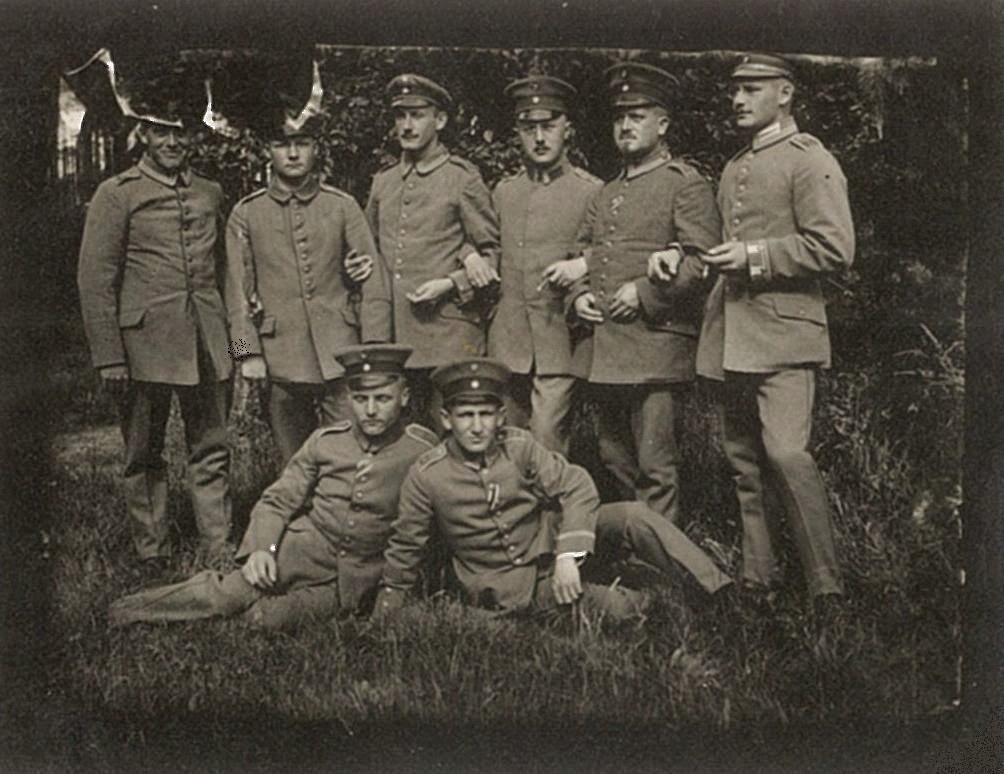
My maternal grandfather Ernst Gerson (Opa), a German Jew living in Hamburg, was called up to fight for Germany in WWI. 

In October 1916 he received three shots through his legs and was taken prisoner of war by the Russians near the river Stochod in Volhynia during an unsuccessful gas attack. 

He was then sent to work in a gold mine in Siberia. After a few months of trying to work in appalling conditions, with inadequate clothing and no pay, Opa and some of the other prisoners realised they had to get away from the mine before winter set in or they would die. 

Opa wrote letters to the Swedish Consul begging for help to get the men out of the mine. When the mine managers found out about this they arrested Opa and took him away to be punished. 

By this time Russia was in a state of complete chaos as the Red and White Armies engaged in civil war after the 1917 Revolution. 

Eventually Opa escaped and made his way back to Germany on foot and by horse and cart and train. He endured constant deprivation, extreme hunger and cold, typhus and constant danger but after 2 years he eventually arrived back home in Germany where his fiancée, my grandmother Barbara, was waiting for him. Of course, later when Hitler came to power, the fact that Opa had fought for Germany counted for nothing and he and his family were forced to flee Germany.


~ Sally Rawnsley